Showing posts with label Julie Ryder. Show all posts

Wednesday, May 10, 2023

Reflection/s

 The Embroiderers Guild, Victoria, Australia is having its annual members exhibition in a few months. I have been rather uninspired, despite the seemingly wide-ranging theme - Reflection (or maybe Reflections, I can't actually remember). 

I have been looking at images here and there, including Notan art, using the positive and negative space. 

I came across an image on 123RF, where you can get copyright images for a small fee. 


(Copyright: <a href='https://www.123rf.com/ profile_movlievyevgenii'>movlievyevgenii</a>)


I cropped the image, printed it out to the size I wanted, traced front and back and then ironed the tracings onto Vleisofix.

Today I cut them out. Then I found some silk that I had dyed at a workshop with Julie Ryder, at the Ballarat Fibre Arts Forum last year or the year before (time has less meaning recently). The silk had been folded before putting in the dye so that the resist was reflected on each folded part. 

The fabric didn't quite fit the image so I used another piece of indigo dyed silk from the workshop in the middle. I had taken some photos of trees reflected in water recently and noticed that the water was not an exact mirror image of the sky.


I tried to replicate that using some silk roving that I had. I have only laid it on so far, no glues or other means of making it permanent, so I need to get to and sew it, hoping it will stay put! 

I have a basic design. Now to try to sew some extra onto it. 

I have decided that it will need some thickness behind it and have cut out a piece of heavy interfacing to back it. 

As I have mentioned occasionally, I use this blog as a visual diary. I was able to look up a past post and see how I did a previous piece. I have not done quite the same thing but it did give me direction and inspiration. It is easier than going through multiple scrapbooks looking for past notes and images. 

Tuesday, April 16, 2013

Workshop exhibition at end of our week.

There was a variety of workshops available at the Ballarat Fibre Arts week.  As I have already posted, I did the resist dyeing with procion dyes.  I used only cotton but some of the other ladies used silk as well.
We attended tutor talks on several occasions, and got to see the amazing work all of the tutors do.  Quite a few of them don't just do what they teach at the workshops, they branch out into all sorts of interesting mediums.  Julie Ryder, our tutor, had a very wide ranging practice and must have a huge CV.
At the end of the week, there is an exhibition of all the classes' work.  I had a lovely time chatting and asking about how people had done things.  Consequently, I missed some people's work as they started taking their work down so they could travel home.  So I didn't take pictures in all the rooms as they would not have looked good with gaps in the displays. And I decided to look closely and enjoy the works rather than get lots of pictures.
So here are some that I got.


These are from Jade Pegler's class - The Paper Object

From Alison Wither's class - Painting with free motion machine embroidery 


These three are from Liz Clay's class.  Textile Translations.  Nuno Felting with Photography and Mixed Media 

Noriko Endo's class.  Impressionist of Japan-Confetti Naturescapes: Exploring Fabric Oil Painting


Anne Small's class. STACK, Stitch, Slash and Show 


John Garrett, USA: Experimental Fibre Constructions with Alternative and Recycled Materials 

Marjolein DALLINGA , CANADA: Sculptural felting; experiment and discovery

Kay  FAULKNER, AUSTRALIA: East meets West: Warp faced weaves
I did wonder if they had brought their own looms and, if not, what they did if they hadn't finished their final pieces.

Saturday, April 13, 2013

I have been away.

It is over a week since I have posted!  I had planned to do some posts that could be put up on a scheduled timetable but got bogged down with trying to get my SWTAFE assignment ready to hand in before I went away to the 2013 Ballarat Fibre Forum week.
Unfortunately, I didn't get the SWTAFE work up to speed, so didn't do the extra posts.  And I have been busy - and out of touch in terms of the internet - during the workshop week.

I must say, one of the reasons I go to the Fibre Forum is that there is no radio, no tv (that I can actually hear) and there are no newspapers.  And no-one talks about the world outside.  So it is a wonderful retreat and I try not to sully it with the internet. (I did do a little, I have to admit. It allowed me to meet up with people from one of my online groups - I missed the official meeting because I lost track of what day it was but I knew they were there and could ask around.)

The classes are always interesting and I really enjoy the week away for reasons other than a retreat from the news of the world.  The workshops offer lots of learning and there are many people there from whom you can gain added inspiration.

I did a workshop with Julie Ryder on resist dyeing using Procion dyes.  We did some resist dyeing using clamping and shibori, to revise our knowledge of the dyeing process.  Another technique I was introduced to was paste resists.  Julie made up some starch based pastes and people experimented with them. There were potato, wheat and rice based mixtures. We also did some resist dyeing using Manutex, with and without dyes included, to add to the fabric we had dyed or to new fabric. We could use stencils, stamps or just brush on this mixture.
Clamping, tie dyeing, peg and fold resist.
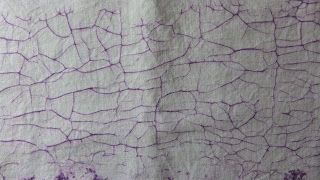
A potato based resist was painted on and left overnight to dry.  It does not dry at an even pace and so it cracks.  In the morning we painted the dye over the paste and it seeped through the cracks. 

The base was a piece that I had clamped-dyed, then I put blue into the Manutex and stamped it. I put a clear dextrine paste over my original dyeing but forgot to put an extra colour over the top, so that just came straight out.  Live and learn.
We went on to chemical resist dyeing using two chemicals that interact with each other in such a way that you can put down a coloured background that won't influence the second colour you put on - provided you do it properly.  I did make a couple of mistakes but, as Julie said, we learn from our mistakes. This last technique was amazing - you can put yellow over a blue background and you will end up with a blue background and yellow design, no green in sight.
These pieces had the remazol base, waiting to dry. Notice that you can do an intense background and then paint over it.
If you look closely, you can see a halo around the pink lines, where the chemical has pushed the base colour away. And the yellow spots are much lighter than the background, which went on first.
The workshop was designed to learn techniques, not come up with finished products.  This is exactly the sort of workshop I like, I don't want the pressure of having to make something by the end of the week.  I much prefer to be able to come home and play around with what I have learnt, take my own time to get the information embedded. Then I can apply it to alternative uses that I have in mind, later.